
Gelman Site 1,4-Dioxane Groundwater Contamination Plume Modeling and Forecasting
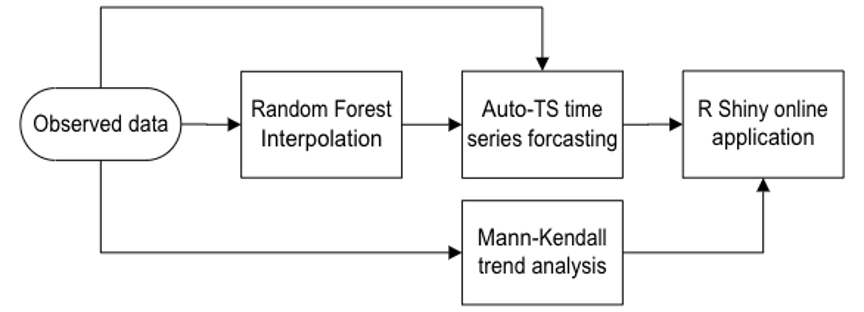
Groundwater systems are intrinsically heterogeneous with dynamic spatio-temporal patterns, which cause significant challenges in quantifying and mapping their complex processes. However, accurate forecasting of regional groundwater contamination is commonly needed to identify its spatio-temporal dynamics, which helps the public anticipate the timing and severity of potential groundwater quality issues and could serve as an early warning system. This study focuses on modeling a plume of 1,4-dioxane originating from the Gelman site beneath the city of Ann Arbor, Michigan. It proposes a novel methodology that accounts for the spatially and temporally irregular and uncertain nature of groundwater contamination data to analyze historical trends in dioxane concentration and predict its transport, including the following key components:
- A random forest interpolation model was deployed to fill or extend gaps in fragmented time series across all monitoring wells;
- The Mann-Kendall test was applied to evaluate trends in dioxane concentrations at various wells;
- An automated time series machine learning (AutoTS) package was used to forecast future concentrations; and
- An R-based Shiny web application was designed to allow visualization and quantification of dioxane contamination analytical data.
This research introduces a novel framework for filling spatial and temporal data sampling gaps in groundwater contamination to offer an effective and promising way to predict future plume concentration and spatial distribution.
- Analyzed historical dioxane concentrations and evaluated trends for 245 sampling wells in R
- Developed a model to forecast dioxane concentrations within the Gelman plume using an automated time-series machine learning package in Python
- Built an interactive web application to visualize and quantify dioxane contamination data